Peter's electronic projects Peter's electronic projects
 Try it now, before building! Click on the transmitter buttons with the
green
labels
on the left and see how the receiver outputs (K1-K8) change. Change
the number of transmitter or receiver channels. Switch the receiver
output type between latched and momentary.
Try it now, before building! Click on the transmitter buttons with the
green
labels
on the left and see how the receiver outputs (K1-K8) change. Change
the number of transmitter or receiver channels. Switch the receiver
output type between latched and momentary.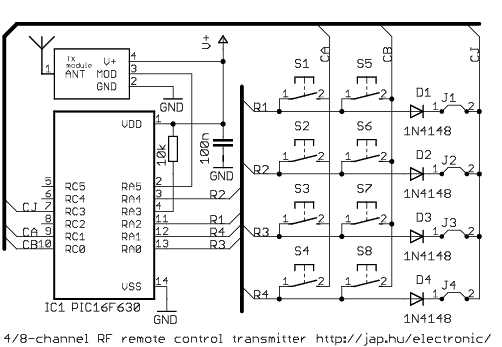
| part | description |
| C1 |
100nF ceramic capacitor |
| R1 |
10k resistor (1/8W) |
| D1-D4 | 1N4148 diode (optional) |
| S1-S8 |
tact switch, DTSM 61N or similar |
| IC1 | PIC16F630 or PIC16F676 microcontroller, pre-programmed |
| TXMOD |
radio
transmitter module, see text (hardware) |
| B1 |
battery between 2-5.5VDC (check TXMOD specs for valid voltage range) |
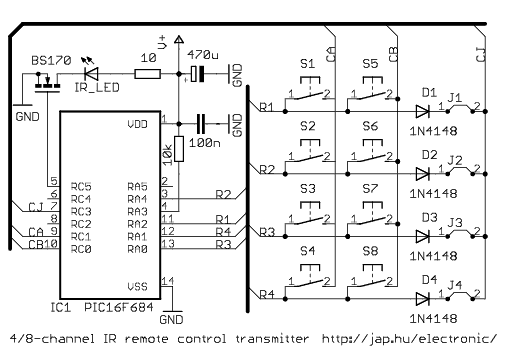
| part | description |
| C1 |
100nF ceramic capacitor |
| C2 |
470 uF 6.3V, electrolytic
capacitor |
| R1 |
10k resistor (1/8W) |
| R2 |
10 ohm resistor (1/4W) |
| D1-D4 | 1N4148 diode (optional) |
| D5 |
IR transmitter LED |
| Q1 |
BSS138 or similar N-MOSFET |
| S1-S8 |
tact switch, DTSM 61N or similar |
| IC1 | PIC16F684 microcontroller, pre-programmed |
| B1 |
battery between 2-5.5VDC (CR2032, 3.6V LiIon battery or 3xAA
batteries) |
| please
observe the corresponding address configuration! |
|
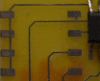 transmitter: no diodes connected |
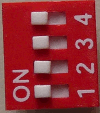 receiver: switches all ON |
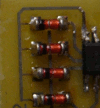 transmitter: all diodes connected |
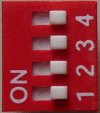 receiver: switches all OFF |
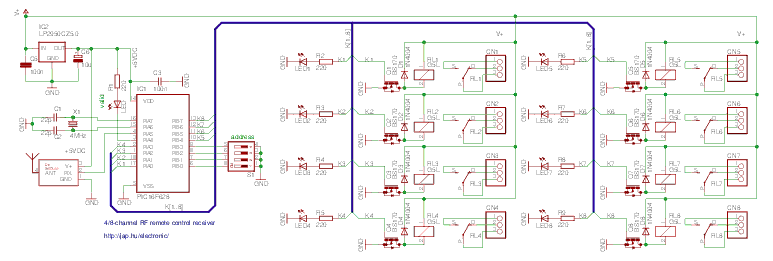
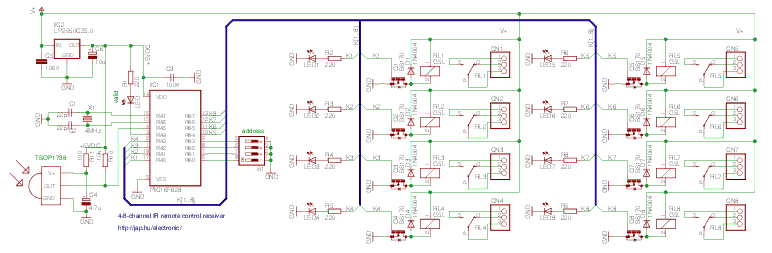
parts list
| part | description |
| C1, C2 | 22pF ceramic capacitor |
| C3, C5 | 100nF ceramic capacitor |
| C6 | 10uF 6.3V electrolytic capacitor |
| CN1-CN8 | PCB terminal block, 3-way (DG301) |
| D1-D8 | 1N4004 diode |
| IC1 | PIC16F627 or PIC16F628 or PIC16F627A or PIC16F628A microcontroller, pre-programmed |
| IC2 | LP2950CZ5.0 voltage regulator |
| LED | 3mm LED (green) |
| LED1-LED8 | 3mm LED (red) |
| Q1-Q8 | BS170 N-channel mosfet transistor |
| R1-R9 | 220R resistor (1/8W) |
| RL1-RL8 | G5LE relay, see text for coil voltage selection |
| S1 | piano DIP switch, 4-way |
| X1 | 4MHz HC49 crystal |
| RXMOD | 3-pin radio receiver module, see text (hardware) |
| please
observe the corresponding address configuration! |
|
| transmitter: no diodes connected |
receiver: switches all ON |
| transmitter: all diodes connected |
receiver: switches all OFF |
The film's screenplay, written by the legendary Samudrala Sr., meticulously adapts the events of the Aranya Parva (The Book of the Forest) from the Mahabharata.
S.V. Ranga Rao (SVR) gave a masterclass in acting as the antagonist Duryodhana. Instead of portraying him as a caricature of evil, SVR infused the character with royal majesty, deep pride, and tragic vulnerability. His dialogue delivery in the court scenes remains legendary. Savitri as Draupadi
Released on January 14, 1965, Pandava Vanavasam set the screens on fire with its gripping portrayal of the Pandavas' exile. It was not just a film; it was an event that ran over 100 days in 24 centres and achieved a 175-day run in some areas. Kamalakara Kameshwara Rao Producer: A.S.R. Anjaneyulu (Madhavi Productions) Writer: Samudrala Raghavacharya Composer: Ghantasala Venkateswara Rao 2. Cast and Character Breakdown
The 1965 Pandava Vanavasam is not just a film; it is a cultural touchstone that brings the timeless lessons of the Mahabharata to life. Pandava Vanavasam Movie -UPD-
For fans of mythology, classic cinema, or simply great storytelling, watching "Pandava Vanavasam" is an enriching experience. It is a testament to the power of cinema to bring our ancient stories to life and keep them alive for future generations. This comprehensive guide, last updated in May 2026, reaffirms that some films truly are timeless.
(1965) stands as one of the most celebrated mythological films in the history of Telugu cinema. Directed by the legendary Kamalakara Kameswara Rao and produced by the visionary N. Trivikrama Rao, the film is a cinematic retelling of the "Vana Parva" (The Book of the Forest) from the Indian epic, the Mahabharata. It captures the trials, tribulations, and unwavering dharma of the Pandavas during their thirteen years of exile.
The film is noted for its powerful performances by legendary actors: Bheema. S.V. Ranga Rao (SVR): Duryodhana. Savitri: Draupadi. Kanta Rao: Lord Krishna. Gummadi: Dharmaraju (Yudhistira). The film's screenplay, written by the legendary Samudrala Sr
The soundtrack and background score, composed by , serve as the emotional heartbeat of the film. The songs are deeply rooted in classical Carnatic music and elevate the narrative.
as Bhima: His powerful portrayal and physical presence defined the character for generations. S. V. Ranga Rao
It offers a glimpse into the high production values and creative storytelling of 1960s Indian cinema. Instead of portraying him as a caricature of
For a long time, classic films like "Pandava Vanavasam" were primarily accessible through film screenings or physical media. However, with the rise of OTT (Over-the-Top) platforms, access has improved. While the 1965 film itself isn't always available on the largest international platforms like Netflix or Amazon Prime Video, it can sometimes be found on regional or niche streaming services. A good place to check is services like Flixjini, which aggregate where to stream classic movies. Additionally, the film is often uploaded in parts or in its entirety on video-sharing platforms like YouTube, making it accessible to a global audience.
as Lord Krishna: Providing the divine guidance that steers the Pandavas through their hardships. Technical Brilliance and Legacy Pandava Vanavasam
The film's success can be attributed to its well-balanced blend of action, drama, and spirituality, which appealed to a wide range of viewers. The movie's grand sets, majestic costumes, and impressive battle sequences set a new benchmark for Indian cinema, influencing future filmmakers.
The Pandavas, led by Yudhishthira (Gummadi), spend twelve years in the forest, facing various challenges, fighting demons, and growing spiritually.
LATCH_MASK EQU B'00001111' sets channels 8-5 to momentary
and
channels 4-1 to latched (toggle) mode. Then use the compiler (MPLAB or
gputils) to
assemble the code.clrf
0x91 ;
ANSEL